
Why The Thunder's New Defensive Rotation Is Statistically Breaking The League

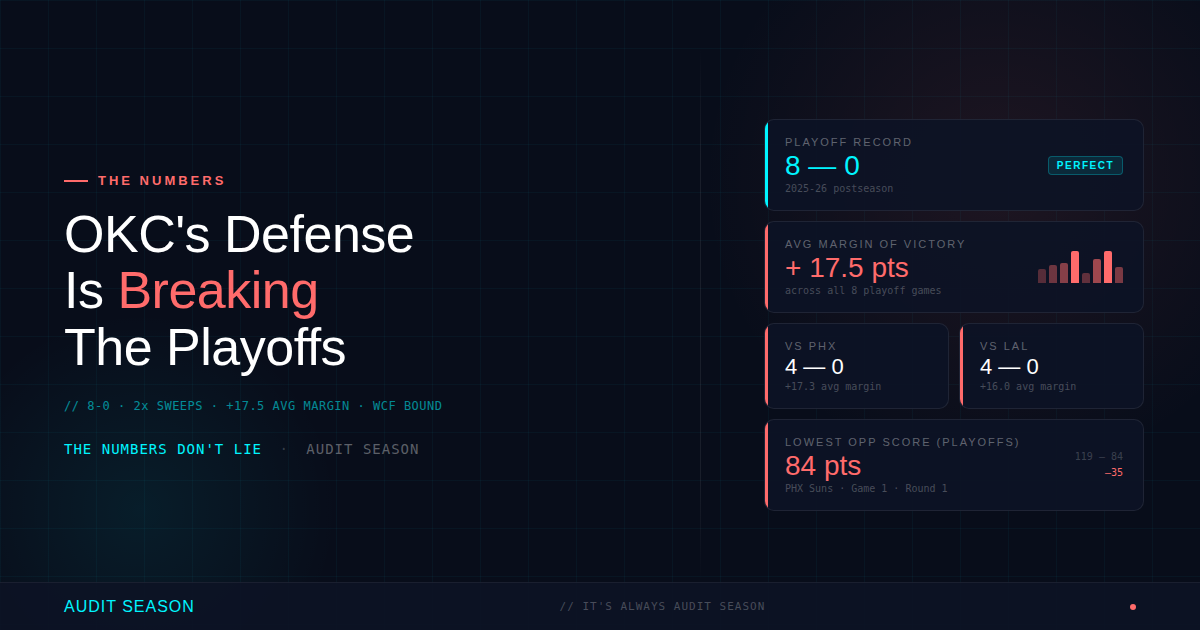
8-0. Two sweeps. Opponents held under 110 points in 7 of 8 games. The numbers don't lie — OKC is running the most dominant playoff defense in years.
84 Points. In a Playoff Game. In 2026.
Game 1 of the OKC–Phoenix first-round series ended 119–84. Eighty-four points. That is not a football score. That is not a typo. That is what happens when the Oklahoma City Thunder deploy their switching defensive rotation against an offense with no answer for length, pace control, and collective scheme.
The Thunder finished the regular season 64-18 — the best record in the NBA. They then walked through the playoffs without dropping a single game, sweeping both the Phoenix Suns and the LA Lakers by an average margin of 17.5 points per contest. What we are watching is not a hot streak. It is a system working exactly as designed.
This Is Not a One-Player Defense
Most dominant defenses in modern NBA history have been built around one anchor — a Rudy Gobert protecting the paint, a Kawhi Leonard chasing the opponent's best scorer. OKC is doing something structurally different.
Their rotation is built on switchability across all five positions. Every player on the floor can guard multiple positions without creating an exploitable mismatch. That means opponents can't run pick-and-roll schemes to isolate a weaker defender. They can't hunt the center on the perimeter. Every switch is clean. Every coverage is contested.
Shai Gilgeous-Alexander anchors the offensive engine, but he also initiates defensive pressure at the point-of-attack level — generating steals and deflections that fuel transition opportunities before the opposing offense can even set up. The defense creates offense. That is a compounding effect most teams can't replicate.
Two Sweeps. One Story.
Round 1 — vs Phoenix Suns (4-0)
| Game | OKC | PHX |
|---|---|---|
| Game 1 | 119 | 84 |
| Game 2 | 120 | 107 |
| Game 3 | 121 | 109 |
| Game 4 | 131 | 122 |
| Avg Margin | +17.3 pts |
Round 2 — vs LA Lakers (4-0)
| Game | OKC | LAL |
|---|---|---|
| Game 1 | 108 | 90 |
| Game 2 | 125 | 107 |
| Game 3 | 131 | 108 |
| Game 4 | 115 | 110 |
| Avg Margin | +16.0 pts |
A few numbers from those tables deserve to be underlined. The Lakers — a team with LeBron James and a functional half-court offense — were held to 90 points in Game 1. The Suns were held to 84. Both of those figures would have been considered historically suppressed even in the low-scoring eras of the 1990s, let alone in today's pace-and-space NBA where 115 points is considered average.
The only game in eight that was genuinely close was Lakers Game 4, a 115–110 final. Every other game was decided by double digits. In the context of playoff basketball, where execution tightens and offenses adjust, that consistency is extraordinary.
7 of 8 playoff wins came with the opponent held under 110 points. The NBA average this postseason is 113.4 points per game.
The Western Conference Finals Is the Real Test
Two sweeps is an extraordinary playoff run. But both the Suns and the Lakers had significant offensive limitations — Phoenix struggled with ball movement under pressure, and LA's supporting cast around LeBron was inconsistent. The Western Conference Finals will match OKC against a team with more offensive sophistication.
The question for any opponent now is structural: can you design a half-court offense that creates mismatches faster than OKC can rotate and recover? The Thunder's switching scheme means you can't pick on a single defender. You have to generate mismatches through motion, off-ball movement, and pace — and you have to do it consistently, not just for one quarter.
No team has done it yet. The margin data tells you why: opponents aren't just losing, they're losing badly, early, with no adjustments working across four games. That is what an elite defensive system looks like when it's fully operational.
Can Anyone Crack It?
OKC's defense has held every playoff opponent below their season scoring average. The West Conference Finals opponent will need to find a scheme that punishes switching coverage and generates open looks before the Thunder can recover. Nobody has shown that ability yet this postseason.
Drop your take in the comments — do you think anyone in the West has the offensive system to finally crack this rotation?