
The NBA Has a $2,000 Problem. And It's Costing the Game Everything.

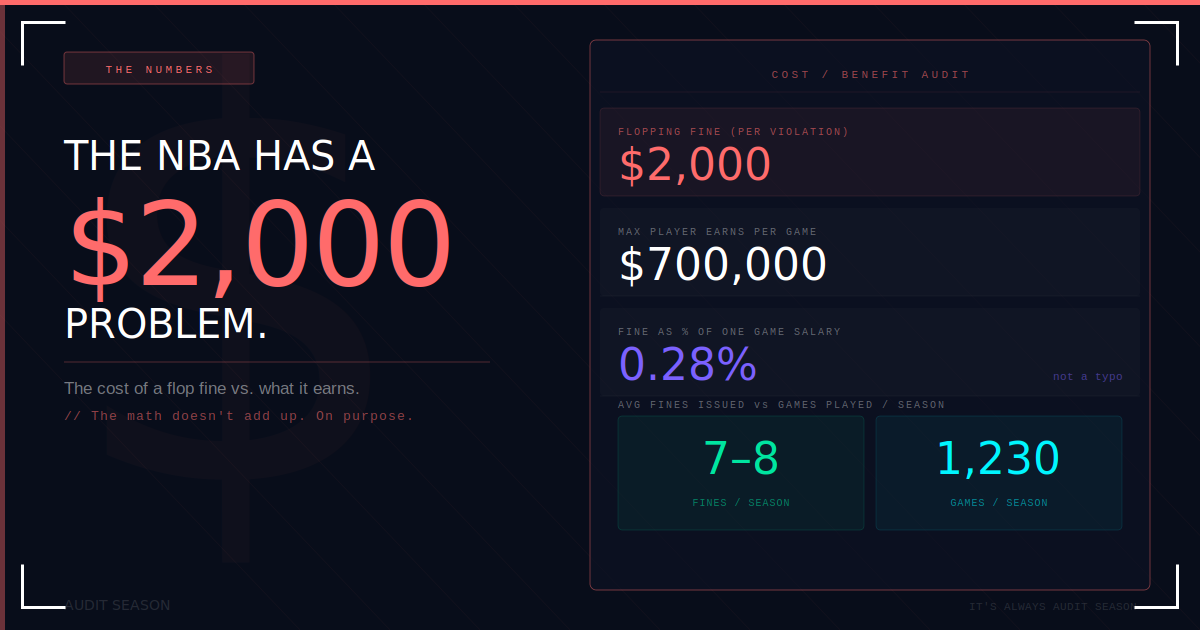
Here's a number that should make every basketball fan furious: $2,000.
That's what it costs an NBA player to get caught flopping. Two thousand dollars. The price of a decent TV. A rounding error on a monthly paycheck for anyone making the league minimum — and an outright joke for the players doing it the most.
The NBA introduced anti-flopping rules in 2012. Fourteen years later, the sport is having its most public flopping crisis in history. The 2026 playoffs have been dominated by the conversation. Jaylen Brown went on stream after the Celtics' Game 7 loss and said outright, "Flopping has ruined our game." Lakers players confronted officials after a Thunder game. Coaches are losing their minds on the sideline. Fans are muting the broadcast. Erin Kirk Site
And the punishment is still $2,000.
Let's audit this.
The Fine Math Doesn't Work
The 2025-26 NBA salary cap sits at $154.6 million. The league's top earners are pulling $50-60 million per year. On a per-game basis, a max player earns roughly $700,000 per game across an 82-game season. Basketball-Reference.com
A flopping fine is $2,000.
That means a max-contract player paying a flopping fine is losing approximately 0.28% of one game's salary. If you earn $75,000 a year, the equivalent punishment would be $210. Less than a parking ticket in most major cities. There is no rational financial deterrent here. The math says flop freely.
Since the anti-flopping rule was introduced in 2012, the total number of publicly documented postgame flopping fines is somewhere around 100-120 league-wide — including warnings. That's only 7-8 violations per season across a 30-team league playing 1,230 regular season games. Fox News
The only documented flopping fine in the entire 2025-26 season was Malik Monk, fined $2,000 on December 1. One fine. One player. One season. Fox News
The Free Throw Problem Is Getting Worse
Flopping and foul-baiting are connected. One gets called by the referee in the moment — and that's where the real damage happens.
In the first 10 days of the 2025-26 season, the league averaged 45.7 fouls per game — the most in 30 years, and up 23% from the 37.2 per game the previous season. Fouls on drives were at 8.5%, up from 7.2% and the highest rate in 13 years of tracking data. NBA
23% in one season. That's not a blip. That's a behavioral shift — players collectively figured out that the whistle is profitable, so they went hunting for it.
The league also averaged 29.8 free throw attempts per 100 shots from the field — and that number was climbing. Three teams were on pace for the highest free throw rates of any team in the past 20 seasons. This isn't about one or two players gaming the system. The system is being gamed at scale. NBA
The In-Game Enforcement Is Even Worse
In 2023-24, the NBA introduced a live in-game flopping technical foul — you get caught flopping in real time, you get a tech. It was supposed to be the fix.
Independent tracking found approximately 26 in-game flopping technicals were called in the entire 2023-24 season — the first year of the rule. Since those first few months, enforcement dropped dramatically. The NBA made the rule permanent in July 2024 despite the low call frequency. WFMD-AM
26 calls in a full season. There are 1,230 regular season games. That's one flopping tech called every 47 games. Anyone who watches basketball knows there are multiple flops per quarter. The rule exists on paper. It doesn't exist on the court.
The ROI on a Flop Is Absurdly High
Here's the number that nobody talks about: what does a successfully drawn foul actually earn you?
The average NBA free throw is worth approximately 0.76 points. Drawing a two-shot foul that wouldn't have otherwise been called is worth roughly 1.52 points in expected value — for free, with zero defensive effort required. In a game decided by 3 points, that's a swing that could change the outcome.
The cost of getting caught doing it? $2,000, charged after the game, if anyone even bothers to review it.
The expected value of a successful flop dramatically outweighs the expected cost of getting penalized. Players aren't being irrational. They're being perfectly rational. The league built an incentive structure that rewards the behavior it claims to hate.
What Actually Fixes It
Three things would move the needle — and none of them require a rule change, just enforcement of rules that already exist.
First, tie fines to salary percentage, not flat amounts. A $2,000 fine means something to a minimum-salary player and nothing to a star. A fine of 0.5% of annual salary scales properly — that's $300,000 for a max player. You'd see behavior change overnight.
Second, call the in-game tech consistently. The rule is already there. Referees need leeway to use it without fear of being second-guessed by the league office, which historically protects its stars from embarrassing calls.
Third, publish the data. The NBA doesn't maintain a fully public archive of flopping violations. Sunlight is a deterrent. If every flop attempt was logged, reviewed publicly, and attached to a player's name — the same way tracking data exposed mid-range avoidance — the culture shifts.
The flopping problem isn't a rules problem. It's a math problem. Right now the numbers say it's worth it.
Change the math. Change the game.
The NBA has all the tools to fix this. It just keeps choosing not to use them. Why do you think that is?