
The Knicks Beat 99.9% Odds to Steal ECF Game 1

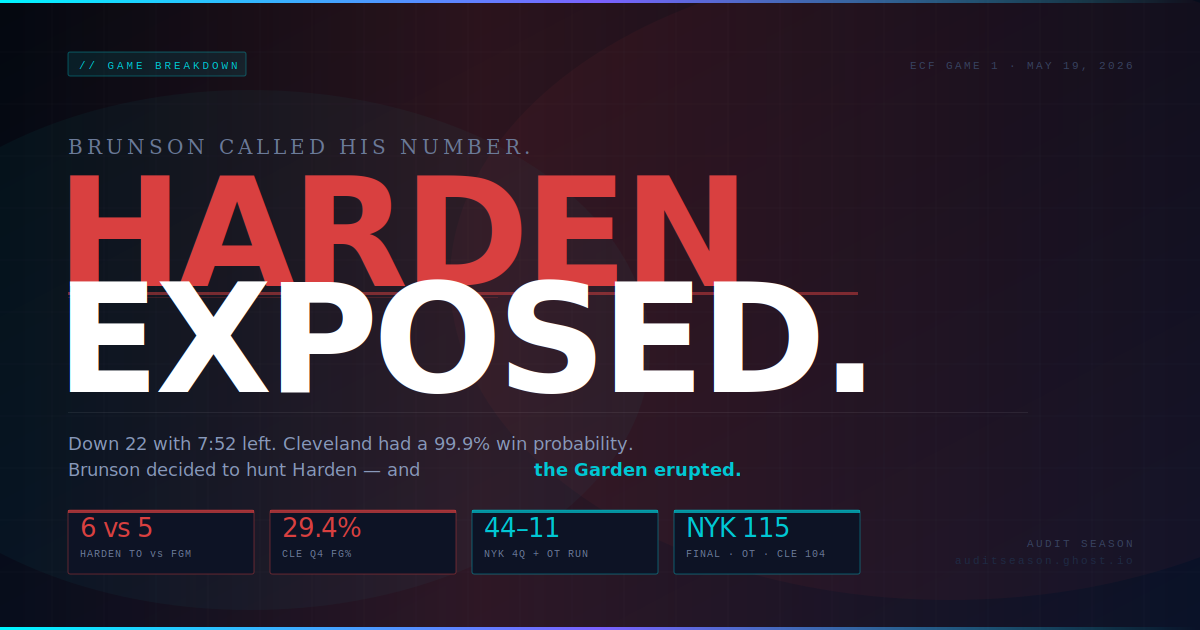
The Knicks Beat 99.9% Odds
to Steal ECF Game 1
Down 22 in the fourth quarter with a 0.1% chance of winning, the Knicks didn't pull off a comeback — they executed a surgical dismantling of Cleveland's defense by turning James Harden into a liability. Here's how they did it, and what the hidden numbers actually say.
Game 1 Result
The Stats That Tell the Real Story
The box score tells you Brunson had 38 points and the Knicks won in overtime. What it doesn't tell you is how improbable this was — or which hidden numbers actually explain it.
Harden's quiet implosion: He finished 1-for-8 from three-point range and coughed up 6 turnovers against 5 made field goals. His legs were gone — the direct result of Cleveland burning through a brutal 7-game series against Detroit just 48 hours earlier. This wasn't a bad game. It was a tank running on empty at the worst possible moment.
How Brunson Manufactured the Mismatch
The Cavaliers had spent 40 minutes doing exactly what they wanted — hunting Brunson in pick-and-roll coverage and exploiting Karl-Anthony Towns in space. It was working. Cleveland outscored New York by 29 between the late first quarter and the 7:52 mark in the fourth.
Then the Knicks did something deliberate: they stopped trying to work around the matchup problem and started creating the one they wanted. Brunson began calling Mikal Bridges and OG Anunoby to screen — not to free himself, but to drag Harden away from help defenders and into isolation coverage in the open floor. The message was clear: bring me Harden.
Coach Mike Brown acknowledged it after the game: "They were doing the same thing with Jalen. So we said two can play that game." Brunson hit five straight field goals targeting Harden, then tied the game at 101 with 19 seconds left in regulation.
The Momentum Swing — 4Q + OT Run Breakdown
The Landry Shamet Variable
With 9:59 left and the Knicks still down big, Brown made a quiet substitution — pulling Josh Hart and inserting Landry Shamet, who had logged just 3 minutes and 13 seconds to that point in the game. Shamet had been largely out of the rotation all postseason before stepping up in two games when OG Anunoby missed time against Philadelphia.
Within possessions: he drew a charge on a driving Evan Mobley, then knocked down a corner three off a Karl-Anthony Towns feed. Deficit: 17. MSG woke up. The Knicks had a pulse again.
Why this matters: The Shamet insertion was the moment the comeback became psychologically possible — before Brunson's Harden targeting even began in earnest. Sometimes the most important play in a comeback isn't a basket. It's the play that makes the crowd believe the basket is coming.
What Game 1 Changes Going Forward
Cleveland will adjust. Donovan Mitchell is better than 26 points on contested mid-range looks, and the Cavaliers won't enter Game 2 on two days of rest. Their physicality and depth — on full display for the first 40 minutes — is real.
But the Knicks have now established something Cleveland can't ignore: James Harden is a target. Every late-game possession will carry the threat of Brunson calling a ball-screen designed to find Harden in space. That psychological weight compounds across a series.
The Knicks are three wins from their first NBA Finals appearance since 1999. This franchise came back from 20 points down three separate times in last year's postseason — records at the time, the largest comebacks since 1969-70. This is no longer a fluke. It's a personality trait.
Cleveland now knows Brunson will hunt Harden in every high-leverage possession. Does JB Bickerstaff move Harden off the ball or hide him on weak-side — and does that create a different problem? Can the Cavaliers fix a broken fourth quarter in 48 hours, or does fatigue linger into Game 2?
Drop your take in the comments.