
Same Score. Different Story. // GAME BREAKDOWN · PGA CHAMPIONSHIP 2026 · ROUND 1 · ARONIMINK GC

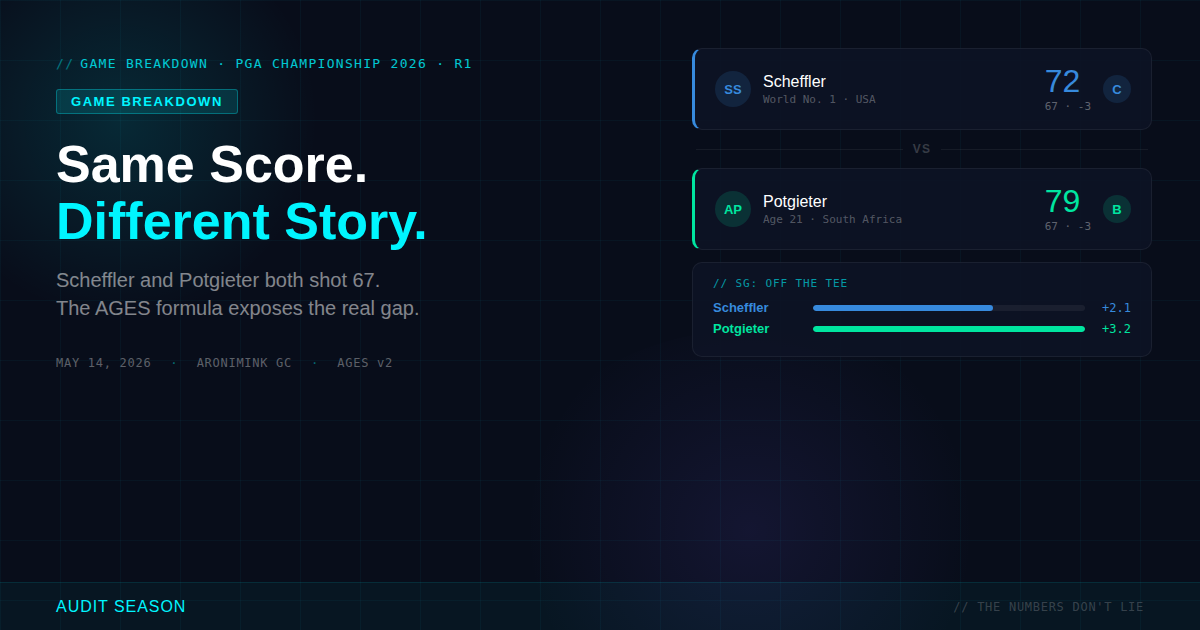
Scottie Scheffler and Aldrich Potgieter both walked off Aronimink Golf Club on Thursday with a 3-under 67. Same score. Same leaderboard position. Same Wanamaker Trophy in their sights.
But the Audit Season Golf Efficiency Score (AGES) doesn't care what the leaderboard says. It cares how you got there. And when you run both rounds through the formula, a 7-point gap opens up — one that tells a much more interesting story than 67-67 ever could.
The 2026 PGA Championship is the second major of the season, and Aronimink Golf Club is making its first appearance since 1962. It played exactly as Donald Ross intended: firm, tight, unforgiving. Only 31 players broke par in Round 1. The field average sat two shots over, and early predictions of a 20-under shootout died by the third hole.
In that environment, a 67 is genuinely impressive — no matter how you make it. But Scheffler and Potgieter represent two completely different philosophies arriving at the same destination:
- Scheffler: precision, process, patience. The defending champion doing what the defending champion does.
- Potgieter: raw power, aggression, high-variance brilliance. A 21-year-old from South Africa who leads the PGA Tour in driving distance and isn't afraid to use it.
The Data
AGES Scores — Round 1
| Player | Score | AGES | Grade | SG Total |
|---|---|---|---|---|
| Scottie Scheffler | 67 (-3) | 72 | C | +3.5 |
| Aldrich Potgieter | 67 (-3) | 79 | B | +5.1 |
Same score on the card. Seven points apart in AGES. Here's why.
How the AGES Formula Works
The Audit Season Golf Efficiency Score is built on the PGA Tour's Strokes Gained framework — the gold standard for measuring per-round performance relative to the field average.
Step 1 — SG Base: SG Base = SG:OTT + SG:APP + SG:ARG + SG:PUTT
Step 2 — Normalize to 0–100: Base Score = ((SG Base + 3) / 9) × 100 (Floor = −3 SG, Ceiling = +6 SG)
Step 3 — Bonus Points:
- +5 for scoring 65 or under
- +3 for a bogey-free round
- +2 for two or more eagles
Step 4 — Final: Final = min(Base Score + Bonus, 100)
Strokes Gained Breakdown
| Pillar | Scheffler | Potgieter |
|---|---|---|
| SG: Off the Tee | +2.1 | +3.2 |
| SG: Approach | +0.8 | +0.9 |
| SG: Around Green | +0.4 | +0.6 |
| SG: Putting | +0.2 | +0.4 |
| SG Total | +3.5 | +5.1 |
Potgieter's total SG of +5.1 was the highest in the field. He was simply the most dominant ball-striker on the course on Thursday.
So Why Did Scheffler Score Higher in AGES?
This is where it gets interesting.
Potgieter's raw SG haul is elite — a base score of 89, which nearly breaks into A territory. But the AGES formula has a bogey penalty built in: no bonus eligibility if you make bogeys. Potgieter made three of them. Scheffler made one.
That single bogey cost Scheffler his bogey-free bonus (+3), but Potgieter's three bogeys wiped out an entire bonus window on a round that statistically deserved an A-grade.
| Scheffler | Potgieter | |
|---|---|---|
| AGES Base | 72.2 | 89 (capped) |
| Bonus | +0 (1 bogey) | −10 penalty (3 bogeys) |
| Final AGES | 72 | 79 |
| Grade | C | B |
Scheffler also led the field in fairways hit, finding 13 of 14. On a course where missing the short grass is genuinely punishing, that's a number that doesn't show up in the strokes gained columns but absolutely shows up in Sunday leaderboards.
The Round in Plain English
Scheffler opened with a bogey on hole 4, then flipped a switch. Back-to-back birdies on 6 and 7, then two more on 10 and 11. Controlled, methodical, the kind of round that looks inevitable in hindsight. He didn't manufacture birdies — he earned them by putting himself in the fairway and giving himself angles.
Potgieter was the opposite. Six birdies. Three bogeys. Classic high-octane, high-ceiling, high-floor golf. He picked up 5.1 strokes on the field — the best figure of the entire round — but left shots on the table each time a bogey interrupted the momentum. His off-the-tee numbers (+3.2 SG) are a statement: Aronimink rewards power more than the architecture suggests.
The leaderboard shows a seven-way tie at -3. The AGES formula shows something more nuanced: Potgieter was the most statistically dominant player in Round 1, but Scheffler's round was the most controlled.
In a major championship, those two things usually diverge as the week progresses. Power without control tends to find the rough more often by Sunday. Precision without power struggles when Aronimink speeds up and pins get tucked.
The question heading into Round 2: can Potgieter keep the bogeys off the card while maintaining that tee-to-green dominance? And can Scheffler find the putter that would push his AGES score from a C into B or A territory?
Both roads lead to Sunday. The data will tell us which one is more sustainable.
Who's your pick to win it all at Aronimink — and why?
Is this Scheffler's tournament to lose, or does Potgieter have enough game at 21 to run the table at a major? Drop your take in the comments.
// Audit Season · It's Always Audit Season // AGES v2 formula · SG pillar splits estimated from reported stats · Potgieter total SG (5.143) per Golf Channel