
Dallas Won. But the Numbers Say Nobody Should Be Happy About It.

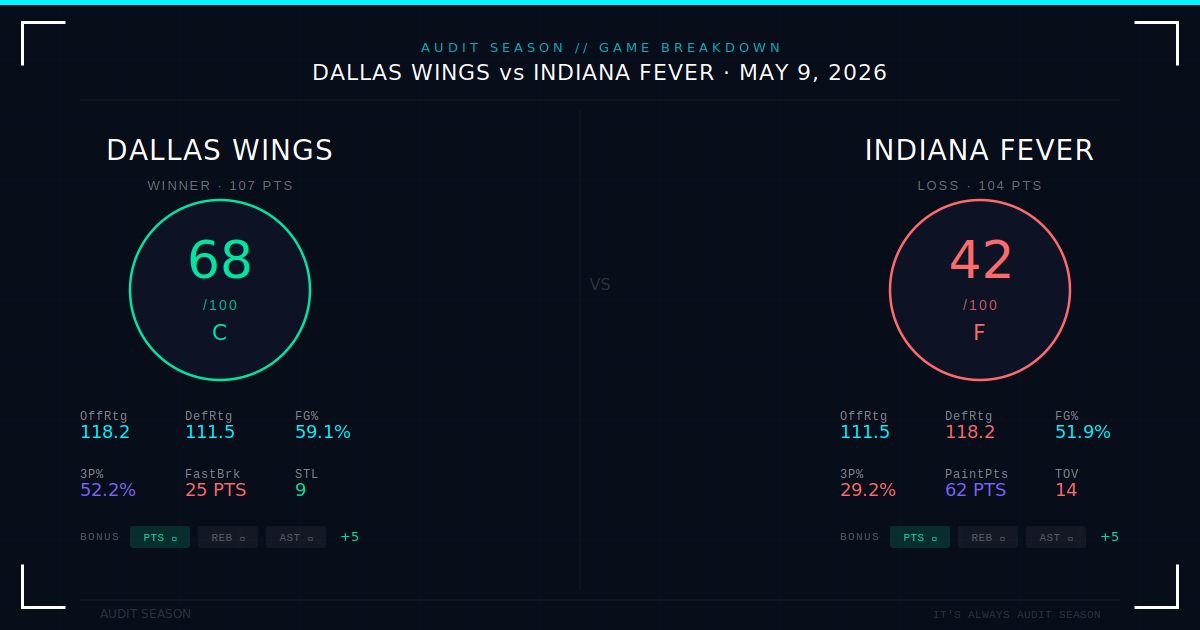
Dallas Wings 107, Indiana Fever 104. On the scoreboard it looks like a competitive opener. The Audit Season Efficiency Score says something different — this was a bad game from both sides, and one team was significantly worse than the other.
Dallas: 68/100 — Grade: C Indiana: 42/100 — Grade: F
A C and an F. In the same game. Welcome to the 2026 WNBA season.
The Audit Season Team Efficiency Score combines offensive and defensive rating into a single two-way number, normalizes it against realistic WNBA team performance ranges, then rewards teams that exceed league-average thresholds in points, rebounds, and assists. A score of 68 is mediocre. A score of 42 is a team that got outplayed in almost every efficiency category that matters.
The final score was 107-104. Three points. But the efficiency gap between these two teams was 26 points. That's not a close game — that's a team surviving on hot shooting and a Fever defense that couldn't stop anything.
| Metric | Value |
|---|---|
| Offensive Rating | 118.2 |
| Defensive Rating | 111.5 |
| Two-Way Score | 110.8 |
| Base Score | 63.2 |
| Bonus | +5 (PTS 107 ✓, REB 34 ✗, AST 26 ✗) |
| Final | 68 / C |
Dallas shot 59.1% from the field and an absurd 52.2% from three on 23 attempts. Paige Bueckers went 8-of-10 for 20 points in her WNBA debut. Odyssey Sims came off the bench and torched Indiana for 20 points on 72.7% shooting. The Wings generated 25 fast break points — more than double Indiana's 12. On paper, dominant.
But the efficiency score doesn't reward shooting variance. Dallas turned it over 17 times, grabbed only 34 rebounds, and their defense — while better than Indiana's offense — still allowed a 111.5 offensive rating. That's not a lockdown performance. That's a team that won because their shot-making was historically unsustainable.
Indiana Fever — 42/100 (F)
| Metric | Value |
|---|---|
| Offensive Rating | 111.5 |
| Defensive Rating | 118.2 |
| Two-Way Score | 104.2 |
| Base Score | 36.8 |
| Bonus | +5 (PTS 104 ✓, REB 41 ✗, AST 23 ✗) |
| Final | 42 / F |
Indiana's defensive rating of 118.2 is the real story. They allowed Dallas to shoot freely, gave up 9 steals off their own ball movement, and surrendered 25 fast break points to a team that had no business running on them. Caitlin Clark had 20 points but shot 38.9% on 18 attempts and committed 5 turnovers. Kelsey Mitchell led the team with 30 points but finished -5 on the floor. Aliyah Boston was the only Fever player who looked like herself — 23 points on 64.3% shooting with a team-best defensive rating of 109.7.
The 62 points in the paint is an interesting wrinkle — Indiana dominated the interior. But you can't win a game by being good at one thing when Dallas is converting 52% of their threes and getting out in transition at will.
Dallas won this game because their three-point shooting was elite on opening night — and that's genuinely hard to sustain. Their efficiency score of 68 reflects a team that won the scoreboard while leaving real performance points on the table. Seventeen turnovers and only 34 rebounds from a team that wants to run? Those numbers will catch up.
Indiana's 42 is more alarming. The defensive rating of 118.2 in game one suggests their offseason improvements haven't translated to the defensive end yet. You can outscore bad defense for stretches — you saw it in the third quarter when they went on a 29-20 run — but over a full game, a defensive rating that bad will beat you.
The score said close game. The Audit Season formula says Dallas was the significantly better team and Indiana has real work to do.
Dallas shot 52% from three in game one. Is that a sign of what this offense can be under new spacing concepts — or just an unsustainable opener? Drop your take below.